 ©copyright by Roberta Naas It isn’t often you get the chance to take a behind-the-scenes look at where a professional football team basically spends the majority of its time during season – in its home training camp. So, even though everyone in my family is pretty much a devout JETS fan, when Timex invited me on a tour of the Timex Performance Center at the new Meadowlands Stadium – Home of the New York Giants — I had to go. Today was the New York Giants vs. Dallas Cowboys game, but before the game, a small group of us toured the performance center, tailgated there and got to go on the field with the Giants during pre-game warm-ups at the new stadium.
Since Timex has been sponsoring the Giants for the past two years (with a contract that runs for another 13 years), it had the naming rights for this state-of-the-art, multi-level practice center that opened in May 2009, which it called the Timex Performance Center. In the lobby are a host of trophies, including the three NFL Vince Lombardi football trophies for the Giants’ three Superbowl wins.

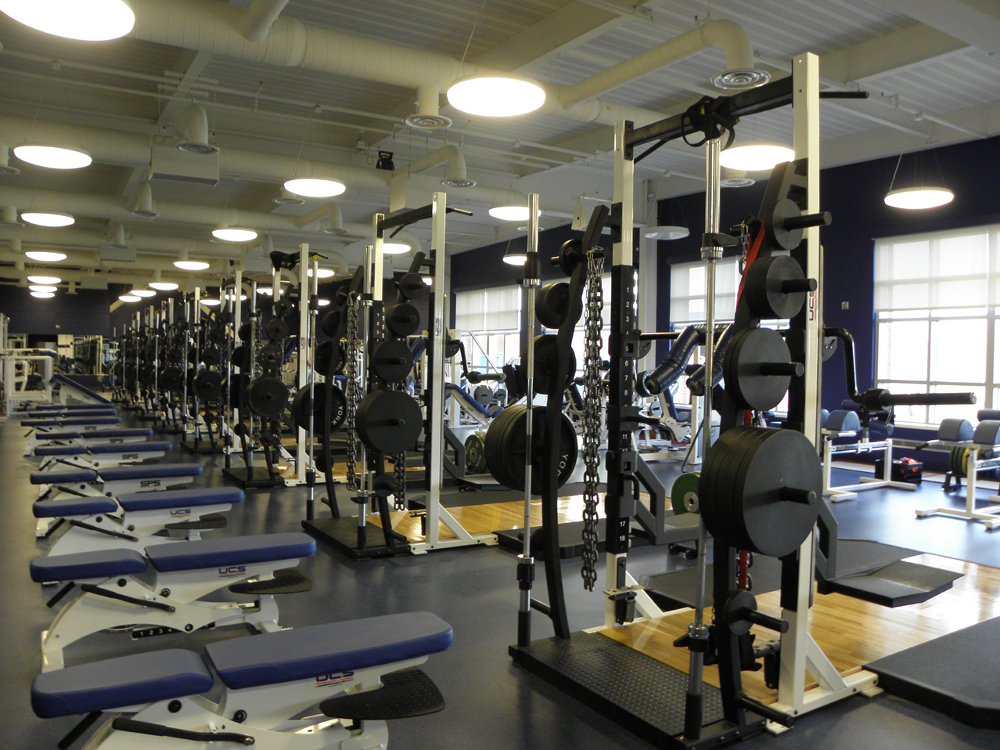
 ©copyright by Roberta Naas The 103,000-square-foot Center houses an amphitheater for press conferences, Giants teachings and coaching lessons, individual coaching rooms split by positions, a television recording studio and an amazing gym and weight room. The locker room is football shaped. The halls are lined with the jerseys and jackets of Giant players in history – both decades ago and fairly recent. A short walk outside and into another building brings you to the indoor full-sized turfed football field, while outside there are four full-length fields.
 ©copyright by Roberta Naas (The Timex Group USA, Inc. entered into this partnership with the New York Giants to enable both groups the opportunity to collaborate on training solutions for athletes who participate in various sports around the world.) While the Timex Performance Center is impressive, as is the new stadium, the Giants today were … well … let’s just say they didn’t win. (The Jets did, though).
Time Capsules: Product — Resoundingly Claret
 For those not in the watch industry – but lovers of it – you may or may not be aware of the sound behind some of the best chimes on the market and the power source of some of the finest watches in the world. What am I talking about? Christophe Claret and his repeaters (watches that chime the time) and other amazing movements. For years this watchmaker extraordinaire has been creating complex movements for some of the world’s finest brands in a behind-the-scenes capacity. While he didn’t always get the recognition he deserved, of late — as more and more brands have spoken out and named their exceptional craftsmen and makers of magic – Claret has become an almost heralded name in the watch movement world.
Christophe Claret is an artist, a master, a genius – all put together in a singular package of determination and perfection. And thank goodness for the watch world. Claret began tinkering with clocks at the young age of 8, picked his profession by 14 and was building his own timepieces as a very young man. He started his own company just over 20 years ago (at the age of 28) in La Chaux-de-Fonds as he ventured into making movements after receiving a commission from Rolf Schnyder of Ulysse Nardin to create 20 minute repeater jacquemarts (the San Marco collection). The story of this watchmaker’s back-stage successes is enlightening and almost overwhelming – with daring feats such as the movements that drive the Jean Dunand Orbital Tourbillon, the Harry Winston Opus 4 or Tourbillon glissiere, and others. From Westminster chimes to flying and twin tourbillons, to grand complications, Claret regularly surprises and delights.
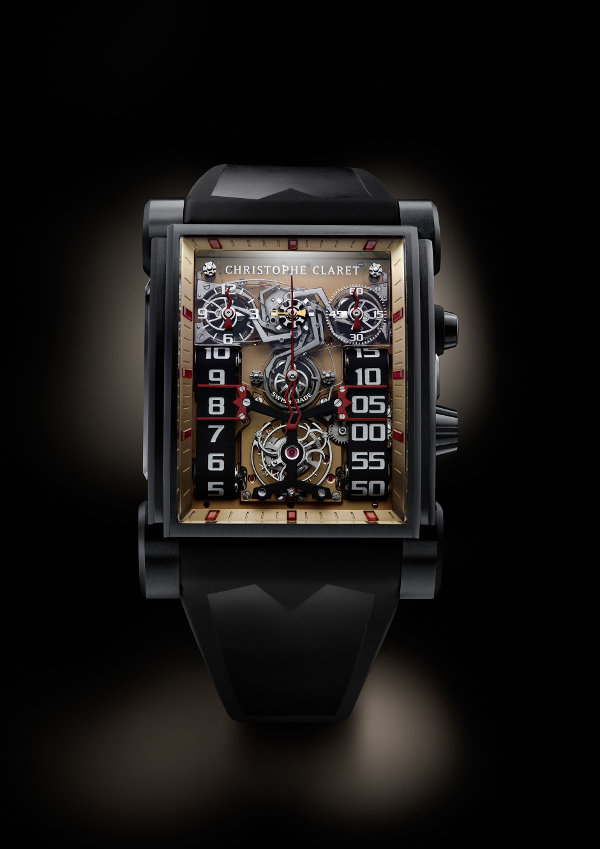
In 2009, in honor of the 20th anniversary of Christophe Claret SA, Manufacture D’Horlogerie, Claret released his DualTow watch — the first grand complication watch to bear the Christophe Claret signature. The mechanical hand-wound DualTow was two years in the development process and is a revolutionary concept in terms of design, technology and display.
DualTow offers a belt display of hours and minutes, a tourbillon escapement, and a patented single-pusher planetary-gear chronograph, that – in Claret style – is equipped with a gong that chimes with each press of the chronograph pushbutton for start, stop and restart. This year, Claret released the DualTow, NightEagle, inspired by stealth aircraft. Its convex black PVD-coated titanium case is entirely machined in-house, and it features three sapphire bridges. DualTow retails for approximately $515,000 to $567,000. Now, just in time for fall, Claret releases this autumnal DualTow with PVD coated titanium case and copper colored dial — an easy-to-read and sublimely beautiful work of art and function.
“For me it is very important to have aesthetics,” says Claret. “The movement must perfect, but the watch must be beautifully proportioned, too.”
www.dualtow.ch
Time Capsule: Commentary – Tissot Rockin’ On
 This morning I went into my old watch collection to pull out a particular timepiece I was on the hunt for … instead I found – well, actually, I found a lot more than I expected!!! But among the things I found were these original Tissot Rock Watches.
It was – and I recall it all so well – 1985 that Tissot, the Swiss brand with origins dating back to 1853, unveiled its Rock Watch collection to the world: a timepiece made entirely of granite from the Swiss Alps. Built in a host of colors, the watch was an innovation in its time. In the United States, that launch 25 years ago occurred in Chicago with a dramatic backdrop of fabricated alps, and all the Swiss execs, including Ernst Thomke, were on hand to explain the complexities of mining the rock and milling it into a case.
The event was a huge one, with Tissot hiring an entire jet to fly the Swiss over for the unveiling. The watch would retail for $195 for a quartz-powered piece of the Alps! It was a huge success, and according to Michael Pucci, the then-head of the brand, “We sold thousands of them. Saks carried them too- and many upscale jewelers. The success run lasted about 4 years.”
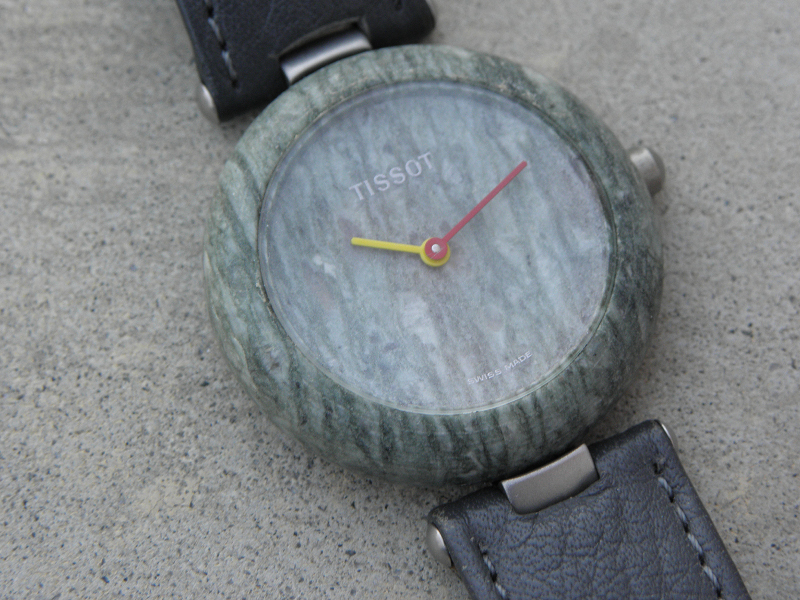
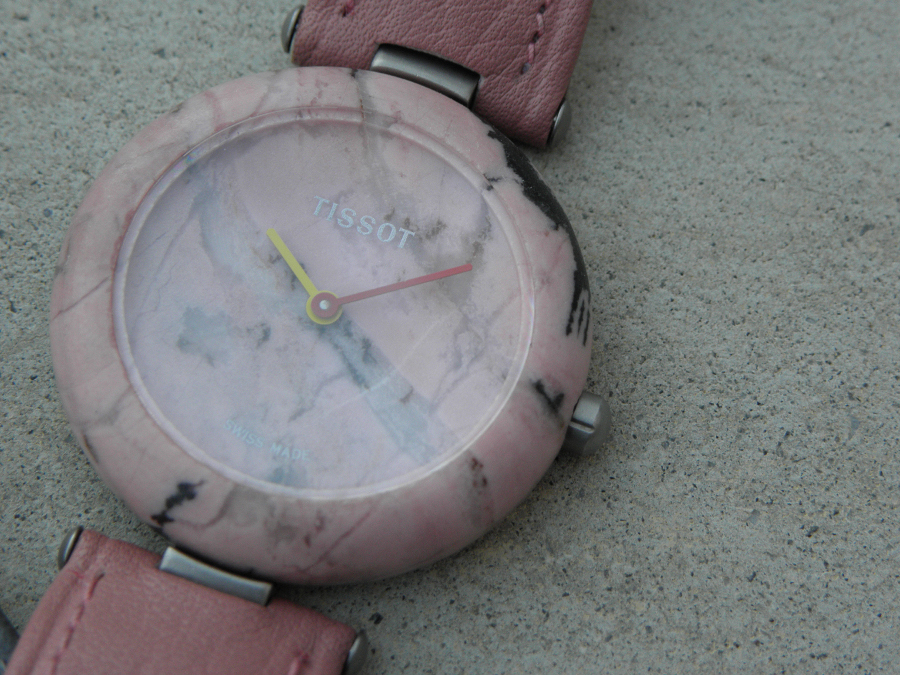 Today, these babies are hard (pardon the pun) to find rarities.
Meanwhile, Tissot has kept on innovating – pioneering in craftsmanship and technology. It offers in its collection today a range from classical Swiss-made automatics to the highly technical T-Touch line of tactical sapphire crystal multi-function watches. Tissot has come a long way since the Rock Watch, baby. www.tissot.ch.  Here: Visodate Automatic.
Time Capsules: News – Americans Honor Veterans
 Today, November 11, is Veterans Day in America – a time when Americans celebrate the bravery and sacrifice of all veterans. Formerly known as Armistice Day, it was originally set as a legal U.S. holiday dedicated to world peace and to honor the end of World War 1 (which officially ended 11/11/1918). Established legally in 1938, the day was changed in 1954 from Armistice Day to Veterans Day to celebrate all those who fought in both World Wars, the Korean wars, and – as we now know – wars ever since. Having had a father who served in the marines, an uncle who served in the Navy, a father-in-law who served in the army and a host of friends who served in our forces, I am proud and honored to salute veterans everywhere.
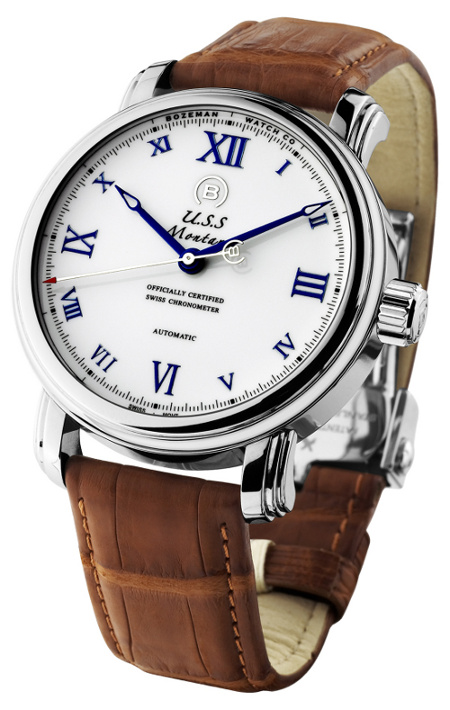
Similarly, Bozeman Watch Co., a top-quality watch brand based in Montana, creates a collection of watches honoring veterans, as well. Built in a limited, numbered edition of 50 pieces, the USS Montana is a COSC-certified Swiss chronometer available with either a strap or bracelet. The robust yet classic timepiece houses a fast-winding modified Val Granges automatic mechanism with 24 jewels that beats at 28,800 vibrations per hour and maintains 48 hours of main spring power reserve.
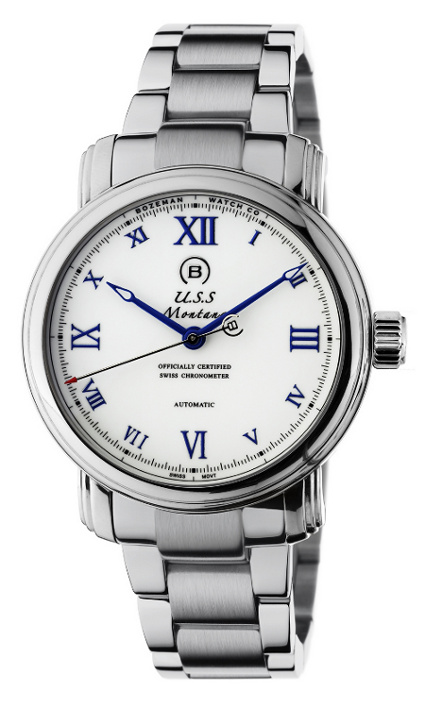 It features a crisp white dial and marine blue Roman numerals and sweep second hand. The 44mm steel case is water resistant to 330 feet and the watch features a domed sapphire crystal. Leather strap options include a hand-made Caiman crocodile, hand-made Louisiana alligator or hand-made Montana saddle leather. A new steel bracelet will be available shortly.
Just four remain available for sale, including the number 45 – the year the Second World War ended. For the sale of that watch – the USS Montana #45 (if sold between today and through Saturday Nov. 13), Bozeman Watch Co. will donate $1,000 to the Survivors of Pearl Harbor Association. This watch retails for $7,900. Please contact info@bozemanwatch.com or visit www.bozemanwatch.com.

Trend Report: Tourbillons
 Greubel-Forsey’s Double Tourbillon 30° mechanism.Ok so in today’s day and age, many will admit that there may not really be a NEED for a tourbillon escapement – after all, our mechanical watches have reached such a sophisticated state of watchmaking that they already are incredibly accurate. Still, these devices remain a pinnacle of watchmaking feats, and a coveted complication.
 Breguet Tradition Ref. 7047PT fusee-and-chain tourbillon.Pronounced “TUR bee ohn” and translated in French as “whirlwind,” this highly precise movement looks and works as beautifully as it sounds. Essentially a tourbillion timepiece houses a special escapement to compensate for errors in timing due to gravity’s effects on the movement. It was first invented by watchmaking legend Abraham-Louis Breguet in 1795. Though he did not patent it until 1801 and did not actually market it in a timepiece until 1805.
Generally, tourbillons fetch approximately $100,000 or more at retail because of the hundreds of parts in them and the hundreds of hours of hand-finishing and assembling required to make them. Tourbillons are a favorite among high  Ulysse Nardin Freak Diavolo.watchmakers to produce – especially in the past decade. Today, watchmakers compete to create the thinnest tourbillon watch, the lightest-weight tourbillon using high-tech materials for components, double or triple tourbillons (such as http://www.greubelforsey.com/), and a host of hybrids that work differently or are displayed differently than ever before. (http://www.piaget.com/)
Whereas in the past the tourbillon watch featured a single aperture on the dial (if the watchmaker chose to showcase the escapement) to view the constantly rotating escapement, today’s inventions can show multiple  Piaget Tourbillon Relatif Jazz.escapements or have the tourbillon carriage attached to one of the hands, which then rotates around the dial. Other inventions showcase the tourbillon pulled off the dial and onto the case side (for example, http://www.concordwatches.com/), or encased in its own sphere so it rotates like a bubble within the dial. There are advancements by some brands in the way the tourbillon operates, as well, with some utilizing constant force devices, chain fusee’s and rotating axis systems.
Because the tourbillon is so coveted, this is often the timepiece that top watch brands elect to use to showcase advancements in technology or haute joaillerie techniques. As such, one may find silicium parts within the  Jaeger-Le Coultre Master Grande Tradition Tourbillon a Perpetuelle.movements of these watches —a cutting edge technique used by fewer than a handful of the finest. (http://www.ulysse-nardin.ch/;
http://www.breguet.com/).
Tourbillons are created by only the finest watchmakers in the world in extremely limited numbers and are a collectors’ delight – one that sometimes requires being on a waiting list for years. (http://www.jaeger-lecoultre.com/)
 Concord C1 Eternal Gravity.
Video: Jumping Seconds
In the world of fraction-of-a-second timing, the Jumping Seconds watch (sometimes referred to as Leap Seconds) is a wonderful tool. Used in the early 20th century on battlefields by artillery men, the jumping seconds feature helped armed personnel determine how far away the enemy was. Because speed and sound travel at different rates, the artillery officers could often see the cannon fire of the enemy before they heard it. By using their jumping seconds watch (which in those days timed to a quarter of a second), they could try to determine the enemy’s location. Today, the function has other uses and is more accurate—timing to 1/8th of a second in the finest pieces. It is also a beauty to behold. Only the finest watch brands (such as Girard-Perregaux, Jaeger-LeCoultre, Panerai, Corum, among others) create this complexity, as it requires a second barrel to power it. Here, we are fortunate enough that thanks to our friends at http://www.awjonlinetv.com/ and http://www.hautehorlogerie.org/, we witness the concept and making of the Jumping Seconds.
Weekend Sojourn: Sophisticated Tools
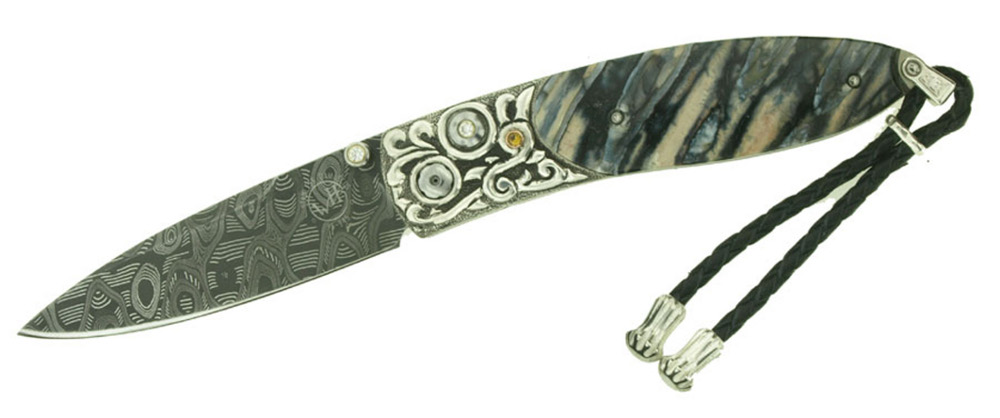
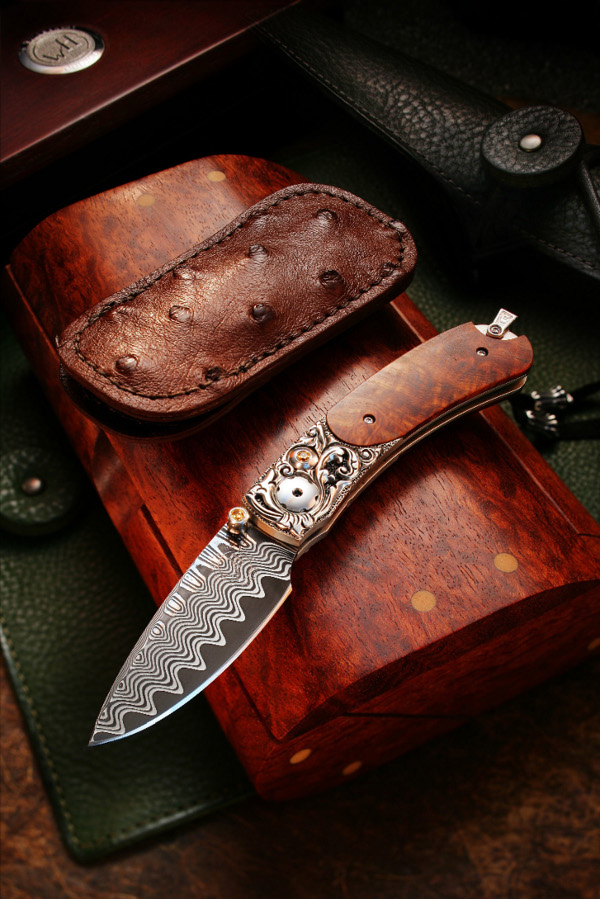 With a strong reputation for building first-class tools for the past nearly 14 years, the William Henry Studio is devoted to excellence. The brand offers an integration of classic natural materials with state-of-the-art alloys precisely machined to aerospace tolerances to leave no margin for error or problem. Every pocket knife the company makes takes more than 7 months to produce and incorporates the work of more than 30 artisans. The process begins with precision machining of the knife alloy – often to 0.0005”, or 1/12th of the size of a human hair – then hand finishing and craftsmanship by master cutlers. In those seven months these knives move from function to form, from tool to art. Some knives are created in limited editions of just three or five pieces, others are more readily built. Some feature skulls, guitars or other decorative modes designed for avid collectors. Shown here are the B09 Kestrel ($1,250), a compact folder machined from a single piece of metal with overlays and inlays of organic materials; and the B05 Monarch Mammoth Tooth with Damascus and Carved Silver (the blade is black tungsten DLC coated with inlaid citrine) $1,750. The Monarch series is an award-winning piece of cutlery in the “investor/collector” category. The elegant shape is a great showplace for exotic materials and acts as a perfect canvas. The woods in this series include black palm root, bias cut and resin-stabilized for durability, ironwood, fossil mammoth tooth (from a wooly mammoth 6000 to 10,000 years old), or rare fossil walrus tusks (ranging in similar dates to the mammoth tooth).
Each knife is sold with an ostrich leather clip case. http://www.williamhenrystudio.com/
Time Capsule: News — Daylight Saving Time
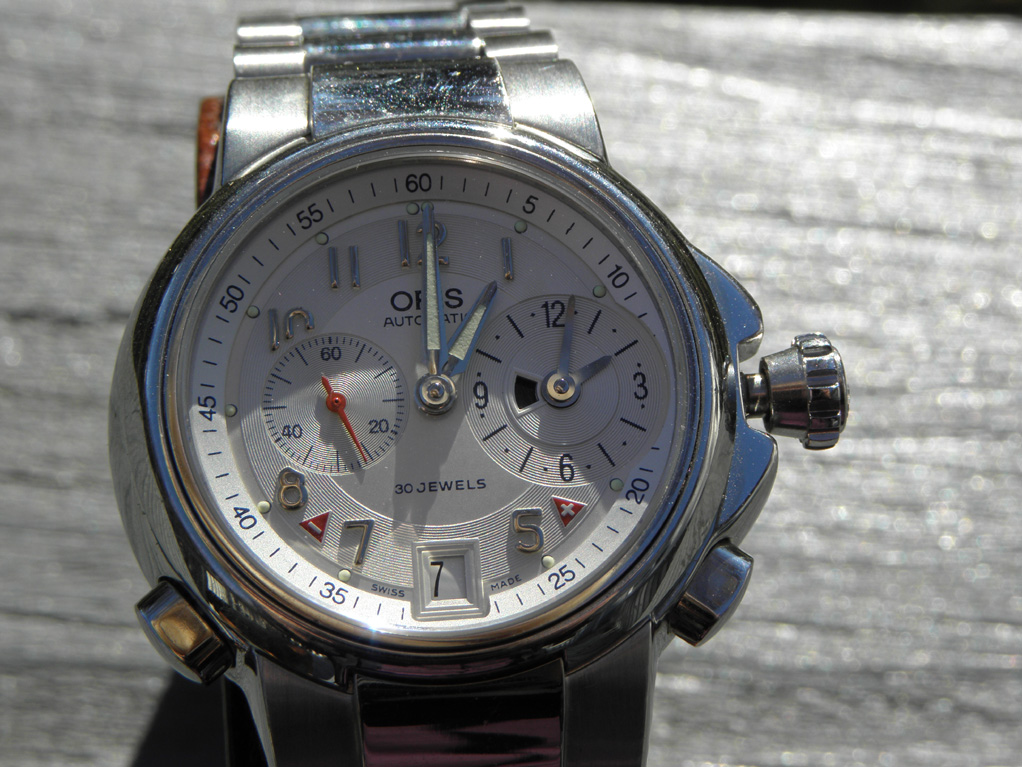 Daylight Saving Time occurs in the United States at 2:00 am on Sunday, Nov. 7. That means that if you don’t stay up until 2 am – you’re going to want to set your clocks back one hour before you go to bed tonight – otherwise you will miss that extra hour of sleep in the morning. Of course, the US territories (US Virgin Islands, Puerto Rico), Hawaii, and most of Arizona don’t participate in DST, but for the rest of us – this is the “fall back” weekend.
The reason for Daylight Saving Time is somewhat obscure. Some say it is practiced in an effort to save energy, but that argument has been called into question. Nonetheless, here’s a little insight into the history of DST for those time junkies who have nothing better to read today.
In 1895, a New Zealand entomologist (studier of bugs) who spent his extra time after work collecting insects, wanted more daylight time for his studies, so he presented a report proposing a two hour daylight saving time program (George Vernon Hudson and the Wellington Philosophical Society). Though the concept wasn’t embraced internationally, it laid the groundwork for Germany and its allies to adopt the idea during the world wars in an effort to conserve coal. Thereafter, many countries, including America, followed suit.
In the United States after World War II, states could select if they wanted to impose DST and on which dates. However mass confusion caused Congress to establish the Uniform Time Act in 1966, which set a protocol for DST times/dates. Still, some US states/territories don’t participate, and argue the usefulness of it. As part of the Energy Policy Act of 2005, the length of DST in America was extended by four weeks, starting in 2007. Additionally, while it is recognized around the world, not all countries practice DST, and those that do, do so on different dates. For more information on time in your zone or around the world, visit www.worldtimezone.com/daylight.html
At any rate, here we are in the Fall Back portion of the “Spring Forward, Fall Back” DST concept. So don’t forget to change your clocks/watch(es).
 As for me — I just wonder with 14 clocks in my office and another dozen scattered throughout the house to be changed (not to mention all the watches to be set back an hour) –how much of that extra hour of sleep I’m really going to get?
Time Capsules: News – Omega Launches Ladymatic
Picture the mid 1950’s – a time of what some called the Easy Life … While there were fears of atomic bombs and the start of segregation in America, it was also a time of growth and movement. Playboy  (photo of original Ladymatic, 1955)magazine was invented in the 1950s, and the Boeing made its first flight. Life Savers Candy and Color TV made their debut that decade, as did McDonald’s. And in 1956 the lovely Grace Kelly married Prince Rainier in the Mediterranean sun. It was an interesting era.
It was also when Omega unveiled its Ladymatic Collection of mechanical watches for women: 1955. Of course at that time the quartz watch hadn’t yet been invented and the mechanical was the only choice for women. The Ladymatic was a hit and was a celebrated series for the brand for years.


Now, more than half a century later, as life has moved to millisecond computer technology, women have joined the workforce en masse and timepieces have changed altogether – Omega reintroduces the  Ladymatic line – but with an incredible twist. The only thing old about the watch is the name. The company went back into the archives to find a fitting name for an all-new technologically advanced visionary series of mechanical watches for women that it just unveiled to the world in Beijing last week.
The new Ladymatic was two years in the design and development stages, and started just on the heels of the unveiling of the Co-Axial 8520 series in 2008 at Basel. The ladies’ watch houses the 8520/8521 Co-Axial movement, which is a COSC-certified chronometer with 50 hours of power reserve and housing the Omega exclusive SI 14 silicon balance spring.
“The powerful movement behind this watch helps us appeal to a more sophisticated female watch audience,” says Stephen Urquhart, president of Omega.
Indeed, the movement is a state-of-the-art caliber, and by coupling it with a high-fashion look, the brand has pulled out all the stops. The watch takes its most feminine design influences from the flowing lines of waves, and features curves on the case sides, which also allow for peeks at the high-tech ceramic rings that are part of the case. The unusual patented bracelet also features asymmetrical wavy links in the first tiers for further undulating appeal.
The watch – supported initially in the ad campaign launch by Omega ambassadress, Nicole Kidman – comes in a variety of diamond and non-diamond versions in steel or in 18-karat rose or yellow gold. It will retail from approximately $6,000 to $33,500. The collection is available in Omega boutiques this month and exclusively through January; thereafter, it will be found in select authorized Omega retailers.
My thoughts: This watch is a must-see, must-feel piece. It is a real beauty to behold and if you’re a woman who enjoys mechanical watches – this one is definitely the one to wear. With the Co-Axial movement in it — it’s a powerful, precise piece. And a COSC-certiifed chronometer. I particularly loved the rose gold version with diamonds becuase it has a lot of weight and a lot of elegance. But the steel models with the black dials have their own panache, too. http://www.omegawatches.com/.
Time Capsules: Product – Bell & Ross Rounds Things Out in Vintage Style
 Recently Bell & Ross- a brand known for its big bold square timepieces – unveiled its Vintage collection. Eight different models in 40 and 41 mm round styles. At first the watches came as a surprise to many – round Bell & Ross? Couldn’t be… what are they thinking? But on closer examination, the thinking became clear. Like many other watch brands today, Bell & Ross saw a gap in its line that needed to be filled: time in the round.
 Inspired by watches of the 40’s, and paying homage to aviators of the time, the recently released collection represents the first time the brand has a round watch. The pieces include a chronograph and an automatic with cases ranging from matte or polished steel to PVD. The line retails from $2,500 to $4,200 and represents a new opening price point for the brand of $2,500.
 As if this bold venture wasn’t enough, the brand – in usual style – kicked it up a notch – just adding a Vintage Officer line of high-polished steel models with domed sapphire crystals for a more distinguished, official appeal. The dials of the 41mm Vintage Officer watches are either black or silver and feature refined, easy-to-read graphics that emulate cockpit instruments. The first two Officers to enlist in the Bell &Ross line up are the BR 123 Vintage Officer – an hours, minutes and seconds three-hand watch, and the BR 126 Vintage Officer – a Chronograph. Both are water resistant to 100 meters.
This Vintage Officer BR123 houses the mechanical automatic ETA 2895 movement with three hands, while the Vintage BR 126 houses the 2894 two-counter chronograph caliber.
At just about the same time the brand unveiled this new price and case shape, it also announced the opening of its new E boutique – a concept that had many buzzing. “The initial goal, first and foremost was tor the branding of Bell & Ross,” says Stacie Orloff, president of Bell &Ross in North America. “It makes it easier for customers where we don’t have stores to buy Bell & Ross, and for customers where retailers don’t have large stock to buy what they really want.” www.bellross.com.