Not often thought about when looking at a watch is the strap that accompanies it and holds it into place. On the finest watches in the world, the leather straps are extremely important—as their sartorial prowess is key to the luxury brands. One rarely thinks about what goes in to the making of a hand-cut, hand-stitched leather strap. From selecting the skins (alligator, calf, ostrich, etc.) to cutting, gluing, sewing and more. Here, thanks to www.AWJOnlineTV.com, and www.hautehorlogerie.org, we have the great opportunity to watch straps in the making and learn about the process.
Weekend Sojourn: Commentary — Watchmakers and their Prowess
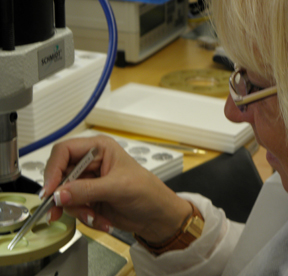 Everyone who wears a mechanical watch should have the opportunity to walk a watch factory and even try their hand at watchmaking. It is a truly humbling experience. Having been in this industry for more than 26 years, I’ve had the opportunity to visit many a hallowed hall of watchmakers. I’ve also, over the years, taken several watchmaking classes and toyed around with taking a few calibers apart.
This past week, though, when I was in Switzerland traveling with Piaget, I had the opportunity to work on putting some of the tiniest watch jewels into a movement. The watch jewel is generally a synthetic sapphire or ruby – an extremely durable material – that is used to reduce friction in the watch’s movement. Well let me tell you, the experience was fun and interesting.
 Every ruby is put in place using nothing but a tiny tweezer and a microscope. I worked with rubies that were so miniscule you could barely see them. To place two rubies took me several tries, as my dexterity is not anything like that of the very patient young woman watchmaker who was demonstrating for me. It took me a couple of minutes – the same time in which she could place many rubies into the watch. It gives an all new perspective on that mechanical movement.
Watch Stops: Pre-SIHH – Baume & Mercier Watches — The new Capeland
 Baume & Mercier brings us a sneak peek today at one of the newest watches slated to be unveiled in January at SIHH in Geneva. The Capeland, a watch that epitomizes the brand’s seaside living philosophy of relaxed lifestyle, offers authenticity and strength of character. Inspired by an historic single push-piece chronograph, circa, 1948, the new 44mm steel Capeland features a curved caseback and “cheve’” shaped sapphire crystal reminiscent of early 19th century “galet” pocket watches.
Each emblematic Capeland watch houses a top-notch self-winding mechanical movement with the complex flyback chronograph function. The Bi-compax caliber, manufactured by La Joux Perret, is meticulously finished with blued steel screws and a circular grained finish for the plate and bridges. The open-worked oscillating weight, adorned with the” Côtes de Genève” design and snailed décor, features the Greek Phi letter as a symbol of balance and perfection. The movement 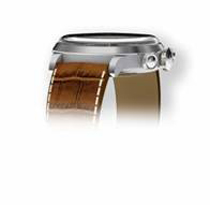 is visible via a transparent sapphire caseback. This bold but sleek new piece has a definitive retro feel with its black domed dial with contrasting gilt hands, tachymeter scale, telemeter scale, classic Arabic numerals and “Breguet” type hands. What’s even better about this great watch is it will probably be priced incredibly affordable.
ATimelyEvent: You will want to be in NYC this weekend to witness Girard-Perregaux’s Museum Masterpieces
By Dara Hinshaw
 Girard-Perregaux cross-shaped pendant watch, circa 1870, yellow gold and enamel, with a cross-shaped movement.We gathered in the Girard-Perregaux Boutique on Madison Avenue, munching on breakfast treats and awaiting the arrival of the masterpieces from the Girard-Perregaux Museum in La Chaux-de-Fonds, Switzerland. They had just arrived this morning, and were still being unpacked. Girard-Perregaux Museum curator Willy Schweizer waited anxiously with us, having flown here from Switzerland for this important event. When the timepieces were unveiled, we were not disappointed.
Celebrating 220 years of watchmaking history, the collection ranges from elegant pocket watches to multiple award-winning wristwatches. One of the highlights is La Esmeralda, a hunter case pocket watch dating from 1889 with a gorgeously engraved rose gold case. By Constant Girard-Perregaux, it is the most famous edition of his Tourbillon with three gold Bridges and was awarded a 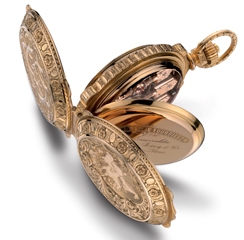 “La Esmeralda,” hunter case pocket watch by Constant Girard-Perregaux, rose gold, 1889.gold medal at the Paris Universal Exhibition in 1889.
Another stunner from Girard-Perregaux is the cross-shaped pendant watch, circa 1870, in yellow gold and enamel, with a movement that is cross shaped, too. The face of the case is decorated with painted enameled religious figures, the back is engraved and enameled with the Ave Maria in Latin, and the bezel is set with diamonds.
The exhibition is enhanced by current collections, featuring timepieces presented at SIHH 2011, as well as limited editions created to celebrate Girard-Perregaux’s 220th Anniversary. “A Tale of Inspiration: Unveiling 220 years of Watchmaking Art” is on display November 18-23, 2011, at the Girard-Perregaux Boutique, 701 Madison Avenue at 63rd St., open 10am to 6 pm, Monday through Saturday. 646-495-9915.
Watch Stops: Pre-SIHH – Piaget Unveils the Phoenix (and Dragon)
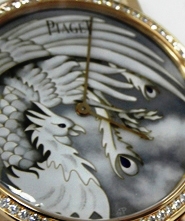 In an exciting new collection that, unfortunately, most likely won’t make its way to the US market, Piaget has created the mythical dragon and phoenix in a stunning series geared for Asia. We had the privilege of viewing these pieces recently in Geneva in Piaget’s workshops and they are definitely collector items! Here’s a quick look at the magnificently enameled Phoenix.
Time Capsules: News – SIHH Sneak Peeks at watches coming in 2012
 Baume & Mercier booth at SIHH 2011Those in the know in the watch world know that the Salon International de Haute Horlogerie (SIHH) is just around the corner. In January, this by-invitation-only exhibition takes place in Geneva and it is the backdrop for the unveiling of the newest timepieces from some of the world’s foremost luxury brands. All of the Richemont Group watch brands (Cartier, IWC, Piaget, Parmigiani, Panerai, A. Lange & Sohne, Jaeger-LeCoultre, and the others) exhibit, as well as a few key independents (such as Audemars Piguet, Richard Mille, Girard-Perregaux and JeanRichard). It is an exciting and exhausting time all at once. Now, in preparation for the show, some of the brands are offering us sneak peeks at a few timepieces that will be unveiled there. We presented the first of these earlier this week, and will contintue bringing some of the newest pieces to the forefront from now until January 2012 when we will witness the most extensive new unveilings. Keep an eye out for these exciting new developments here at Atimelyperspective.com.
Time Capsules: Commentary — Fun Facts about the Birth of the Wristwatch
Fo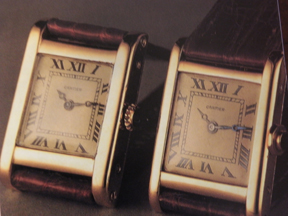 Cartier Tank Watches, ca 1940sr those of you who are history buffs or those interested in a little more fun information to pack in to your thought processes about watches, we are bringing you a little insight into the just-over-a-century-old wristwatch era. Sure there are a few prior “watches for the wrist” on historical record (Patek Philippe in 1868, Audemars Piguet in 1893 and Girard-Perregaux), but the first real made-for- the-wrist watch made its debut in 1904, in the form of a Cartier Santos.
The birth of the wrist watch was spurred by several things, 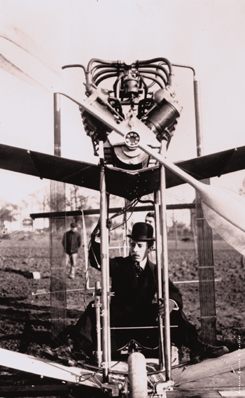 Alberto Santos-Dumontincluding the South African Boer wars of 1899-1902, wherein the military officers liked watches on the wrist for easier accessibility than pocket watches. In fact, several brands made wrist watches for the military – but the average consumer did not easily embrace the concept of a wrist watch. Men thought them effeminate and women were not supposed to be looking at the time, so they didn’t need a watch on the wrist.
In 1904, Brazilian aviator Alberto Santos Dumont, who was known to fly his dirigibles around the Eiffel Tower, expressed to his friend Louis Cartier the desire for a watch he didn’t have to take out of his pocket when trying to operate the flying machine. Cartier built him a wristwatch, called the Santos-Dumont, which the company shortly thereafter put into production as its first series-produced wristwatch, calling it the Santos.
After that, it was all an open playing field and many brands jumped on the wrist watch band wagon. In 1908, Eterna built the first wristwatch with alarm. Years later with World War 1 in full swing, military officers and aviators found wristwatches crucial pieces of equipment. Omega, Movado, TAG Heuer (then Heuer) introduced 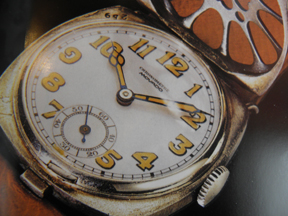 Movado chronomeeter, ca. 1914 with protective grid for on battlefieldschronograph wrist watches for the armed forces and the public in general. In 1916, Cartier created the Tank LC, a rectangular watch fashioned after the first armored combat vehicle. The wristwatch was a superb success and the era of watches for the wrist was in full swing. As the decades progressed, other milestones and trends in wrist watches ensued – but that’s a story for next week.
News: Christie’s Geneva Auction of Important Timepieces Acheives Multiple Record Prices – Would you pay $2.3 Million for one watch?
In Geneva the Christie’s Auction of Important Timepieces spanned nine hours in length, with buyers from 39  countries participating. The result was record breaking. The top two lots sold for more than $2 million each and six lots sold for more than $1 million. The top lot was a rediscovered pink gold Patek Philippe wristwatch, ref. 3448, sold for US$2.3Million. The calendar wristwatch with moon phases was built in 1968 by Patek Philippe and was only recently uncovered by Christies. Other outstanding lots included the 1953 Rolex “Neptune”, ref. 8382, which sold for more than $650,000 — five times its estimate. This was the only non-Patek Philippe watch in the top 10 selling lots. As to my take… well, my phantom bidding stopped at $5,000. I walked away with nothing.
Watch Stops: Pre-SIHH – Audemars Piguet Says Happy Birthday Royal Oak with Open-worked Ultra-Thin Limited Edition
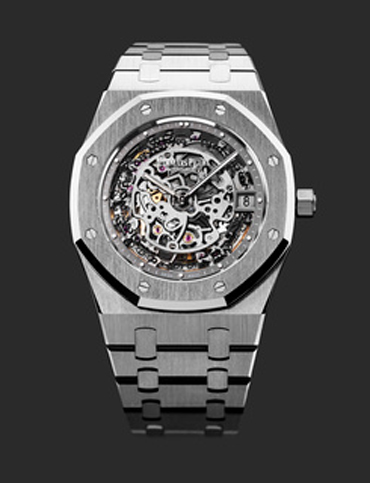 The year was 1972. No, this is not about flower power or other 70’s era memories. This is about the legendary Gerald Genta designing the daring and bold Audemars Piguet Royal Oak watch – a luxury sport timepiece that wowed the world with its magnificent steel case and gold price. The Royal Oak was an overnight success, and today- as Audemars Piguet celebrates the 40th anniversary of the Royal Oak in 2012 – the collection remains one of the most coveted luxury lines in the world.
For the 40th birthday of the Royal Oak, Audemars Piguet has deftly blended old with new, heritage and tradition with visionary foresight. The newest Royal Oak Limited Edition 40th Anniversary watch features a 39mm case – as did the original. However, it is an Open-worked Extra Thin beauty crafted in platinum – and in a limited edition of 40 pieces, naturally. The stunning work houses the ultra-thin self-winding Calibre 5122 that is just 3.05mm thick – and beautifully skeletonized. The movement features an anthracite color achieved by galvanic treatment. The exquisite finishings (circular graining, satin brushing and more) are all done by hand. The monobloc oscillating weight is entirely made in 22-karat gold and bears the raised inscription “AP Royal Oak 1972-2012.” The beautiful timepiece is a wonderful tribute to the Royal Oak’s heritage. Here we bring you a sneak peek at the watch, as its official unveiling isn’t until January 2012 at the SIHH in Geneva.
Weekend Sojourn: Writing in Style – Montblanc’s new Custom-made Nib
 Ever wish you could write with a fountain pen without all the scratching, leaking and other little annoyances that often go along with use of this treasured instrument? Now you can.
Montblanc has developed a tailor-made computer software program to analyze one’s hand writing and create a bespoke fountain pen Nib – custom made according to one’s individual writing speed, angle, pressure and more. Nib service (not including pen): $850. Add a great Montblanc fountain pen and you’ve got one of the most special writing instruments ever. Montblanc took several years to develop the high-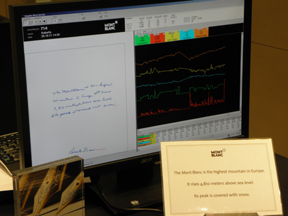 tech computerized system that analyses hand writing, and is investing heavily in establishing the program in select boutiques around the world.
I had my handwriting analyzed and discovered I hold my pen at a very unusual angle that would require my pen nib to be sharpened on two sides differently from the off-the-rack nib. I write very fast and press very heavily, requiring other nuances in the bespoke creation of my nib. It is a fun, relaxing and informative session and you are not obliged at the end to purchase the custom nib if you don’t want to –but why wouldn’t you? This system offers a great way to reinvent hand writing with fountain pens. Bravo, Montblanc.