Time Capsules: Breaking News – HYT Watches with Liquid Time?!

This one is  way cool — and certainly different. Here, A ATimelyperspective brings a first look at the newest HYT watch – slated to be unveiled in BaselWorld in March.  The timepiece is the first ever featuring mechanical and liquid time indications.

From HYT — the Hydro Mechanical Horologists – the watch movement is a manual-wind with 65 hours of power reserve. The Liquid module for the time indication functions thanks to two pistons moving the liquid into the tubes. Super high-tech and really cool. We won’t see the actual timepiece for a while, but here is a video of the concept and a peek at the movement. Not any wonder that a visionary piece like this would be the brainchild of Vincent Perriard, most recently of TechnoMarine and before that, Concord, and Bruno Moutarlier, the former Industrial Director of Audemars Piguet.  The truly high-tech, innovative timepiece should retail for somewhere around $45,000. More to come soon, stay tuned.

Time Capsules- News: Baume & Mercier Shows the Charitable Side of its Moments

By Dara Hinshaw

A few nights ago, we joined Tourneau at the Tourneau TimeMachine for Baume & Mercier’s Winter Seaside Celebration; the main floor was packed with people.  Baume & Mercier, known for its affordable luxury timepieces, partnered with Tourneau to benefit the charity Love146, which works to end child sex slavery and exploitation.  The evening was filled with strong emotions thanks especially to a photo exhibition titled “Into the Light” by Pulitzer Prize-winning photojournalist Carolyn Cole. Commissioned by Baume & Mercier, Cole’s powerful photographs of children illustrate the mission of Love146.

 “We wanted to show our strong partnership with Tourneau and with Love146,” says Alain Zimmermann, CEO of Baume & Mercier, who noted that the brand’s Actress Emmanuelle Chriqui joined Baume & Mercier to host their Winter Seaside Celebration benefiting Love146 at the TourneauTimeMachine in New York.tagline “Life is About Moments” should be true for everyone. “Through Love146 these children may be able to come back to a normal life. You can look at their photographs and see the hope in their eyes.”

 Baume & Mercier North American president Rudy Chavez said he was first introduced to Love146 by one of its co-founders, Rob Morris, in 2008. Chavez   traveled to Southeast Asia and met the children and their caregivers firsthand. “Seeing the children gave a real face to the issue. We wanted the children to have special moments of their own.”

 At the event, Baume & Mercier and Tourneau presented a check for $25,000 to the charity. Additionally, a silent auction for a pair of Baume & Mercier Hampton watches with commemorative Love146 engravings was part of the evening, with 100 percent of the proceeds going to the charity.  Baume & Mercier and Tourneau’s efforts demonstrate the heart of the watch industry, wherein many brands support important philanthropic causes.  We here at Atimelyperspective will dedicate some December gift-giving time to presenting those charitable involvements. Stay tuned.

Time Capsules: Commentary – Fun Facts – The Wristwatch from the 1920’s to 1940

Recently, we brought readers a little insight into the birth of the wristwatch – for those who enjoy a little history and some fun facts.  Continuing that saga, which covered the turn of and the first two decades of the 20th century (see that coverage here), we now bring you perspective on how the wristwatch evolved over the ensuing two decades.
The first wristwatches, used by military and becoming more popularly accepted in everyday life by 1920,   were mechanical timepieces that were wound manually by the wearer.  However, as watchmakers strove to make wristwatches smaller and more wearable, the self-winding wrist watch finally made an appearance. It was English watchmaker John Harwood who is credited with having invented the automatic self-winding wristwatch, for which he applied for a patent in 1923. Still, with the economic crisis in the 1920’s and due to some inherent technical flaws, self-winding wristwatches really did not begin to enjoy their production heyday until the late 1930’s and early 1940s.
Throughout the 1920’s, wristwatches became the preferred mode of time telling – with women seeking to don them as fashion statements and sports enthusiasts and explorers looking to them as functional instruments . As a result of these two realms, the 1920s saw the rise of the Art Nouveau an Art Deco wristwatch styling – with stunning gold watches set with diamonds and gemstones that reflected the era. First floral and sinewy designs came into place, followed by a geometrical style that remains one of the most emulated eras of wristwatch design.  Brands such as Cartier, Van Cleef & Arpels, Chanel and Piaget, among others, were leaders in this realm.  In 1929, Jaeger-LeCoultre succeeded in creating the world’s smallest movement in the Caliber 101– a recognition it still holds today.  This opened up a host of exciting design possibilities.
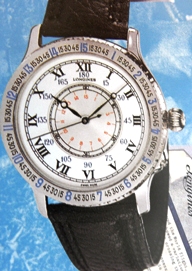
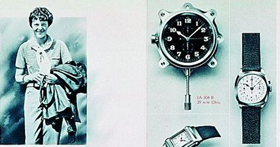
Conversely, the rugged wristwatch that could time anything also became important. Mercedes Glietze made history in the mid-1920’s when she swam the English Channel wearing a Rolex watch. The watch, submersed in water for 10 hours under trying conditions, maintained perfect time and became the first water-resistant timepiece. Rolex named it the Oyster. In 1927,Charles Lindbergh worked with Longines to create the Hour Angle pilots watch. In the 1930’s, Jaeger-LeCoultre released the now-famed Reverso watch – created for polo players who wanted to protect their timepieces. The Reverso swiveled in its case and could turn over – with a solid gold plate on the back that the players would turn out during games. In 1932, Amelia Earhart donned an Omega wrist chronograph when she became the fistr woman to cross the North Atlantic solo by air.
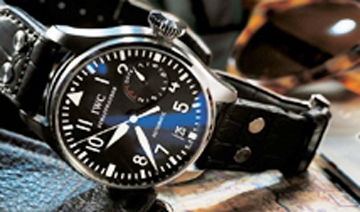
Other great strides in watchmaking came in the 1930’s, as well. IWC, for instance, developed the first anti-magnetic pilot’s watch in 1938, with a soft inner iron case to guard against magnetic fields that could throw timing off. Breitling introduced it firs wristwatches with slide rule bezels for pilot calculations, and other watchmakers began perfecting chronograph wristwatches.  By the close of the 1930’s the race was on to create ever more accurate and functional wristwatches, and to bring design to new levels.  The 1940’s to the 1960’s were wrought with creativity – but that’s a story for another time.  Stay Tuned.

Weekend Sojourn: Dinosaurs Invade the Franklin Institute

Looking for something to do that is great fun and maybe even informative? Plan on going to Philadelphia for a weekend – and try to be there  on December 10, when an exciting new exhibit makes it debut at  The Franklin Institute.

Giant Mysterious Dinosaurs is set to premiere December 10, 2011 and run through April 15, 2012. Giant Mysterious Dinosaurs showcases two dozen humongous actual skeletons, dinosaur recreations and full-sized robotics.   The exhibition includes the largest dinosaurs to be displayed in this country, some as long as 70 feet — excavated from such remote regions as Patagonia and the Gobi Desert of Inner Mongolia.   The exhibition also lets visitors get hands-on by going on a dino dig and handling real fossils.

The spectacular collection belongs to the world’s leading dinosaur collector, Don Lessem. “Dino” Don, a Philadelphia area resident, has excavated and re-created dinosaurs from Argentina to Mongolia, including the world’s largest meat-eater and plant-eater.  He was advisor to the movie Jurassic Park, and has written more than 50 books for children.

This should be a roar!

Video: Ralph Lauren Watches — His View

We’ve covered some of the most beautiful and classic watches in the past year by Ralph Lauren — and while our words and pictures certainly say a lot — no one can express his view of watches better than Ralph Lauren himself. In this video, he not only talks about watches in terms of fine luxury Swiss products, but also in terms of the attention that must be paid to detail when building these masterpeices. This video is superbly illustrated and walks you through many of the watchmaking processes. It’s definitely worth the time!

Off the Cuff: Stefan Johansson Watches

For the past three weeks I have been wearing the Stefan Johansson Vaxjo chronograph timepiece with date indication and alluringly colorful dial. This watch went to the America’s Cup World Series races, did a few laps at a local racetrack, and some hiking. It withstood everything with valor, timed the races wonderfully with the 5/10 second counter, and made some good impressions along the way with colleagues and bystanders.

The brand, founded by Swedish race car driver Stefan Johansson, is designed to capture the essence of racing with its design and technology. The model I wore is a bold and powerful Mark VIII automatic chronograph with white dial and racing flags as the markers. It has a super cool raised-scales bony crocodile strap on it – this alone garnered a lot of attention.

The chronograph was easy to use and – in daylight — easy to read thanks to a convex anti-glare sapphire crystal. While large – at 47mm – it did not overpower my wrist at all, but rather drew attention to it thanks to the great strap and colorful dial. The watch I wore was crafted of steel, but they also offer black PVD coated pieces. It is water resistant to 3ATM and has an exhibition caseback for viewing the Valjoux 7750 caliber – which is absolutely beautifully finished. In fact, this watch would look great wearing it with the back side out – the movement is that nicely finished. Because Stefan Johansson watches are created in limited editions of 250 pieces or fewer, you are part of an elite group of those in the know when wearing one – especially when you learn that every watch is worn by Johansson himself or by fellow professional drivers during real racing events to test it.

The only downfall to the watch that I was wearing was a simple issue: with white hands (albeit they are outlined in black) against a white dial, it wasn’t always easy to tell the time. Additionally, it did not have SuperLuminova markers so night-time reading was fairly unobtainable.

Other than those slight flaws, the watch – with 45 hours of power reserve – worked like a charm – even when I wasn’t wearing it thanks to the easy-to-use 4-setting programmable watch winder it is sold in. Every watch comes with its own watch winder. My opinion- don’t buy white on white, but do take a close look at this much focused statement-making watch. It retails for $7,500.

  (For background on the Stefan Johansson brand, see our previous post here.)

Weekend Sojourn: Visiting the Swiss Watchmaking mecca of La Chaux-deFonds

Exhibit at the clock museum. Watch lover visiting Switzerland? If so, most likely you’ll want to schedule a visit to the mecca of Swiss watchmaking, La Chaux-de-Fonds. It is a quick stop, but many brands call this district home. The capital city of the 1,000-meter-high district of La Chaux-de-Fonds, is the canton of Neuchâtel– where many brands took roots hundreds of years ago. Winter paralyzed the local farmers of yore, who had little to do with their time when the snow set in. Watchmaking provided a great hobby, and then became a great tradition.  Among the brands with roots in this region are Jacquet-Droz, Girard-Perregaux, Omega, Movado, TAG Heuer, Greubel-Forsey and a few others.

Today the watchmaking city of La Chaux-de-Fonds (and Le Locle) has received recognition as a UNESCO World Heritage Site because of its exceptional universal heritage and value.  The town, which suffered extensive damage due to fires in 1794, wherein it was pretty much decimated and was totally rebuilt, is one of the few that still situates residential housing side-by-side with artisanal workshops. In fact, the town is an odd mix of modern glass and steel structures and old tile-roofed homes. Before going, try to slate a quick watch factory visit. Also, while there, the watch museum is a must.

 Since the city and its surrounding canton remains one of the most lively and important Swiss watchmaking centers, it is the home of the Muse’e International d’ Horlogerie (International Museum of Watchmaking). The museum showcases the history of timekeeping projects and products, from sundials to water clocks to table clocks, wall clocks, pocket watches and more.  It is one of the richest collections in Switzerland with more than 4,500 exhibits. In the park outside the Museum is a giant tubular-steel carillon clock with digital readout that was built about 30 years ago. It chimes the time every quarter-hour.

La Chaux-de-Fonds is also rich with art (the Muse’e des Beaux-Arts is an impressive neo-classical building with a collection of Van Gogh, Delacroix and Renoir, among others), architecture (with many buildings designed by La Chaux-de-Fonds architect Le Corusier, nee Jeanneret), and even automotive heritage (this city is the birthplace of Louis Chevrolet (born 1878), founder of the Chevrolet Motor Car Company).

Time Capsules: News – Winners of the 11th Annual Grand Prix d'Horlogerie de Geneve Announced

Just a few days ago, the 11th Annual Grand Prix d’horlogerie was held in Geneva –this is the watchmaking awards event of the year — a wonderful event chocked with emotion, entertainment and serious tribute.   Winners were in a host of categories – and you get to see here a vast array of timepieces.   

The Grand Prize — the L’Aiguiller d’ Or — most special of all — went to DeBethune for its titanium cased DB28 — with spherical moon ball, blued steel, silicon/platinum balance wheel, triple pare-chute shock-absorbing system and floating lugs.  Other winners, voted upon by a panel of collectors, watchmaking experts and journalists, include:

 Best Ladies watch: Boucheron Crazy Jungle Hathi – a stunning watch with bejeweled elephant dial and superb Girard-Perregaux movement. We covered the Crazy Seahorse piece in the collection here.

Best Men’s Watch: The Hermes Arceau Time Suspended, which we have covered several times here at Atimelyperspective.

Best Jewelry and Artistic Crafts Watch: Van Cleef & Arpels, Lady Arpels Polar Landscape. We covered the African piece in the collection.

Best Sports Watch: TAG Heuer Mikrotimer Flying 1000 Chronograph, which we have shown here.

Best Design watch: Urwerk, UR-110, which we have covered.  

The Petite Aiguille Prize for watches retailing for less than 5,000 Swiss francs went to Montblanc for its Star Worldtime GMT Automatic. Covered here.

Best Complicated Watch: Zenith’s Academy Christophe Colomb (Equation of Time). The Best Watchmaker prize went to Vianney Halter, who has created some of the world’s most alluring timepieces. The event also showcases a Special Jury Prize that goes to the Patek Philippe Museum, and a Public Prize that goes to Audemars Piguet for its Millenary 4101.

Time Capsules – Style Watch: Raymond Weil Freelancer Dons Holiday Colors

Raymond Weil is a player in the fashion timepiece world –always a step ahead of the trends. Now, the brand releases its much-coveted Freelancer watch in hot colors for the season in a new line extension called Freelancer Crazytime. Four new colors remerge including rich holiday red, eggplant, chartreuse and orange. The Swiss made mechanical timepiece retails for $5,700.