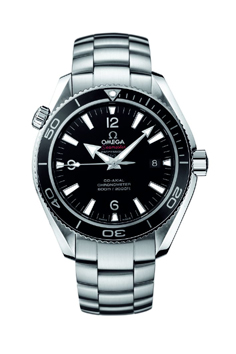
 As watch companies forge ahead with new materials for cases and bracelets, as well as for movement parts, the race is on to find tougher, lighter-weight and ever more resilient materials that withstand the tests of time. Omega is one brand that has developed numerous materials, including a union of ceramics and Liquidmetal® that it utilizes in its Seamaster Planet Ocean Liquidmetal® Limited Edition watch. This watch, which was unveiled last year but is just garnering major attention thanks to the technology behind it, is the world’s first to bond ceramics and Liquidmetal®.
The Liquidmetal® alloy essentially consists of five elements: zirconium, titanium, copper, nickel and beryllium. Its amorphous metal structure enables it to bond seamlessly with the ceramic bezel. It appears silver and the look is a striking contrast to the black ceramic diving bezel and ceramic dial. The Liquidmetal® alloy is a metallic material whose fusion temperature is half that of conventional titanium alloys, but when cooled, its hardness is three times as great as stainless steel – making it a rugged dive watch. The timepiece is created in a limited edition of 1948 pieces (the year Omega unveiled its Seamaster line). To create this watch, the ceramic bezel rings are formed first; then the numbers and the fine lines of the minute scales are engraved into these ceramic bezel rings and polished. The alloy is heated and pressed into the cavities in the ceramic material, after which any excess Liquidmetal® is removed.
The OMEGA Seamaster Planet Ocean Liquidmetal® Limited Edition, with stainless steel case and bracelet, houses OMEGA’s self-winding COSC-certified chronometer Co-Axial caliber 2500. It is equipped with a unidirectional rotating bezel, helium escape valve and screw-in crown. The watch is water resistant to 2,000 feet. It retails for $5,700 – a small price to pay for a big leap in technology.
Watch this video to learn more about the LiquidMetal® Technology.